
Founder & Board Member at PRNEWS.IO, content marketing platform helping brands be mentioned in online media. Official Member at Forbes Business Council
[Case Study] Why SEO Teams Rely on Medialister for Scalable Link Building
Max Roslyakov, founder of Xamsor and former SVP at Semrush, starts from a simple observation: large AI models (ChatGPT, Anthropic, etc.) do not sell paid slots in their responses, so brands cannot “buy” their way into the search results, as was the case with traditional performance marketing. To appear in AI responses and maintain visibility, companies must strengthen their organic presence through SEO and systematic link building.
At the same time, the link market is overheated: placement prices are at historic highs, and a significant portion of offers are low-quality or outright risky from a search engine perspective. In this environment, the winners are those who know how to:
transparently compare prices and terms,
find relevant platforms,
and manage a portfolio of backlinks and PR mentions at scale, rather than collecting them manually from dozens of providers.
The Industry's Problem: Vendor Chaos and a Lack of Transparency
According to Max’s observations, a typical SEO agency or brand developing a link-building strategy faces several systemic challenges. Taken together, these make link building not only expensive but also very “cumbersome” from the perspective of the operational models of agencies and in-house teams.
Dozens of disparate suppliers. The link-building market is fragmented: dozens of marketplaces, private resellers, and niche exchanges. This creates a burden on focus and increases transaction costs.
Opaque pricing. Different platforms sell placements at vastly different prices, and it’s difficult for agencies to determine whether a client is paying a “market” price or overpaying by several times.
Poor inventory descriptions. Many platforms limit themselves to domain metrics and the site’s general theme; marketers cannot see what the actual ad looks like, where it is placed, or what content restrictions apply.
Low delivery rate. Some marketplaces consistently fail to deliver 30–40% of orders (due to cancellations, editorial rejections, or missed deadlines), triggering a flood of correspondence and conflicts.
High operational stress. Every failed placement results in a 5–10-fold increase in communication compared to a successful order—coordination with the client, finding a replacement, recalculating KPIs, and reporting.
Solution 1: Fatgrid as a Transparency Infrastructure
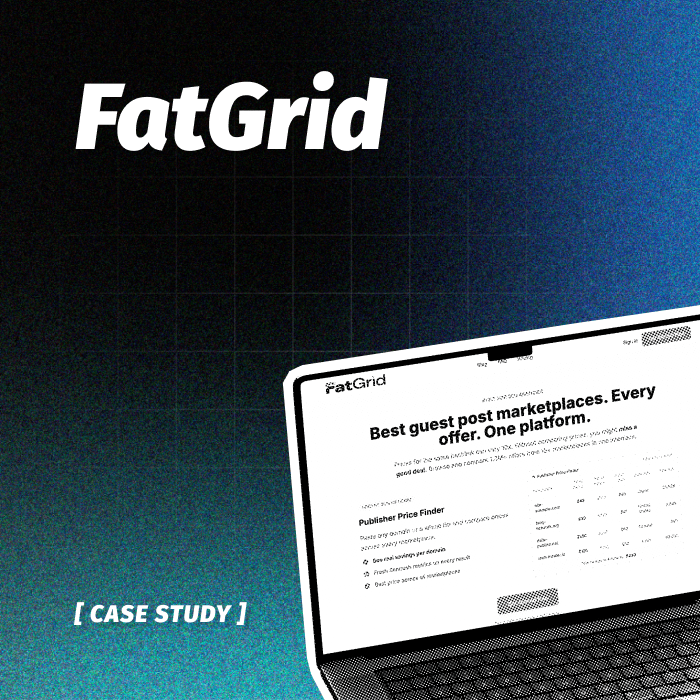
Fatgrid emerged precisely as a response to this chaos. According to Max, the idea grew out of personal frustration: with ADHD, he found it difficult to keep track of dozens of suppliers, manually compare them, and stay focused. So he began aggregating data into a single “focused” interface—and that’s how an internal tool grew into a product.
Key elements of the Fatgrid model:
Inventory aggregation. Hundreds of thousands—and eventually over a million—offers from 20+ of the largest guest-post and link-insertion marketplaces are aggregated on a single platform.
Price comparison. Fatgrid positions itself as a “guest posting/backlink price comparison engine”: users can see how much similar placements cost on different platforms and choose the best offer.
Up-to-date metrics. Semantic and behavioral metrics are pulled directly from Semrush and Fatgrid’s own tools, which reduces the risk of working with “outdated” data.
Focus on trust. Site selection and reporting formats are built on the idea that a brand should earn trust through mentions in professional contexts, rather than through artificial link inflation.
In this way, Fatgrid transforms link building from a chaotic market into a cataloged inventory—what DSPs and SSPs did for advertising is now happening here with guest posts and PR placements.
Solution 2: Medialister’s Role in This Ecosystem
In Max’s opinion, SEO agencies and brands need an editorial placement marketplace. He highlights several platform features that are critical to the industry:
Detailed inventory is the industry standard. On Medialister, each offer displays metrics, live examples of publications, and even the specific section of the website where the content will be placed. This is crucial for premium publications: every placement is an investment in “best-in-class backlinks,” and the market is gradually coming to expect this level of transparency as the norm.
E-commerce experience. The ability to add multiple publishers to a cart, place an order, and, if necessary, immediately add a copywriting service—this is the application of familiar e-commerce logic to B2B editorial advertising. On an industry-wide scale, this lowers the barrier to entry for agencies and standardizes the purchase of “media packages.”
A comprehensive service for top-tier media. High-end media outlets do not accept “just any” content; they need well-written material that meets editorial standards. The ability to order copy and placement in a single window eliminates friction between the agency, the copywriter, and the editorial team and establishes a new service standard in the industry.
High delivery rate as the market’s new KPI. Max compares: some marketplaces have <60% of orders fulfilled, the market average is around 70%, while Medialister delivers >90% successful publications. For the industry, this means a shift in focus from “number of offers” to “reliability of execution” as the key parameter for choosing a platform.
It is telling that Max also mentions scale: the 100,000+ offers in the Medialister catalog are enough for a typical agency to operate for two years without needing to turn to other marketplaces. This illustrates the trend toward consolidating inventory across a few “anchor” platforms.
Start Using Medialister Now
Sign up and get access now